Case Study · Home Accessibility
Westlake Home Safety: From First Click to Finished Install
Neckles IO · Engagement 2026 · Belleville, Ontario
- Client
- Westlake Home Safety, bathroom safety and home accessibility installations, serving nine municipalities in Southeastern Ontario
- Engagement
- Website, reservation flow, installer job portal, lead automation
- Stack
- Static HTML (no framework), owned relational database with role-based row-level security, automation layer
Westlake Home Safety installs bathroom safety conversions (tub cut-outs, grab bars, accessible fixtures) for homeowners across Southeastern Ontario. Their customers skew 55 and older, their work is ad-driven, and their sales process runs through an in-home assessment. The business needed two things at once: a website their actual audience could use, and a way to run jobs that did not depend on one person's inbox.
Accessibility as a market advantage, not a checkbox
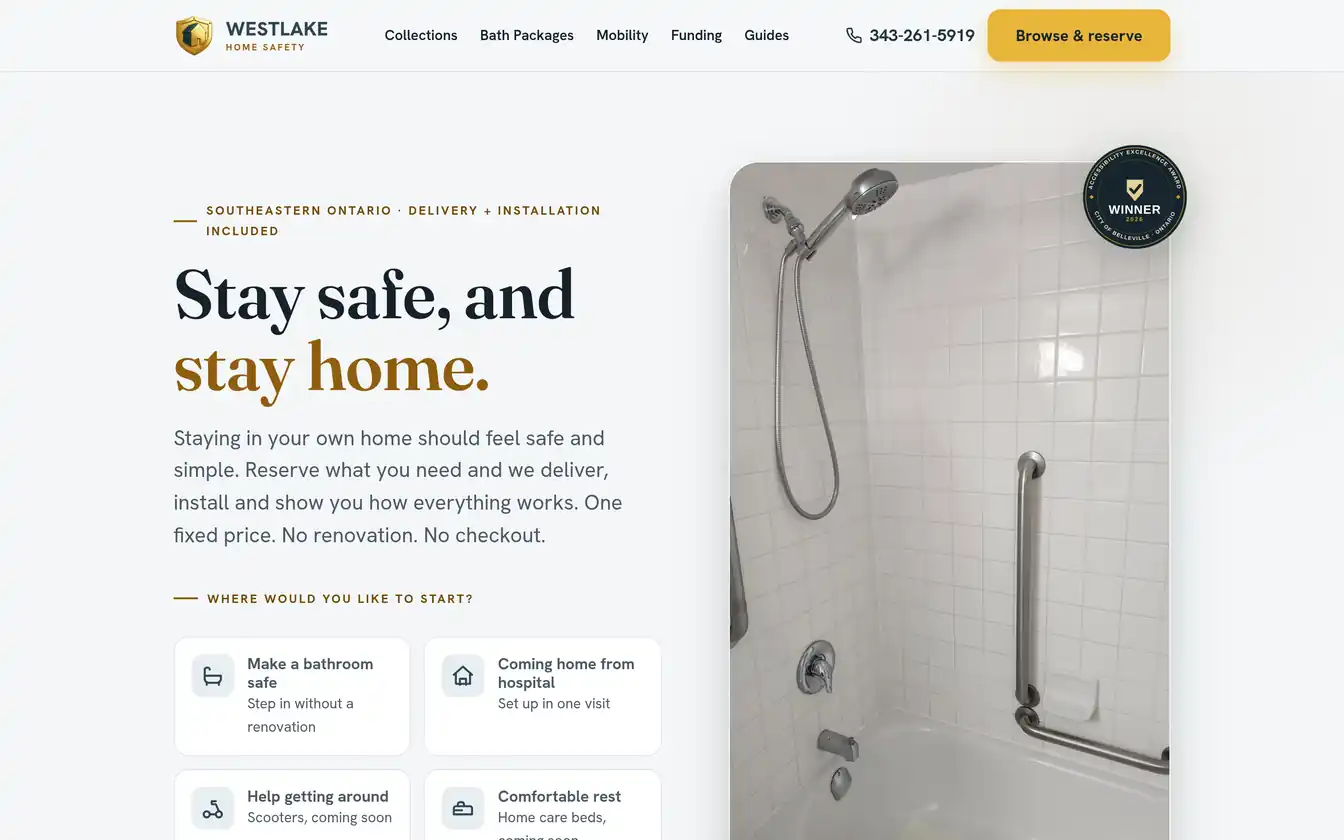
The site was designed for the people who will actually use it: larger base type, verified contrast ratios, generous tap targets, visible focus states, and reduced-motion support, all built into the design system rather than retrofitted. For a 55+ audience, accessibility is simply legibility, and legibility converts.
The structure follows how customers think, not how catalogues are organized: outcome pages like “a safe bathroom” and “coming home from the hospital” rather than product SKUs. Pricing is data-driven from a single source file, so the price on the page, the price in the cart, and the price in the structured data that search engines read can never disagree. A guides hub answers the questions families actually search for, with sources cited to Canadian public-health data.
The copy follows a strict honesty standard: funding programs are explained in plain language without a single overpromise, there are no invented reviews, and there are no stock photos. The gallery is real installations, labelled by town.
A job portal built for the field
Behind the site is a portal that carries every lead through the full lifecycle: new, contacted, assessment booked, quoted, booked, installed. Admins see the whole pipeline; installers see only the jobs assigned to them. That separation is enforced in the database itself, not just hidden in the interface.
The installer view is phone-first: today's and tomorrow's jobs, tap to call the customer, tap to navigate to the address, tap to mark the work done. When a job is assigned, the installer is notified automatically with everything needed for the visit. No one phones the office to ask what is next.
Capture that does not lose leads
Every reservation writes to two independent paths: the database that drives the portal, and a conventional email notification. If either path fails, the lead still lands. The automation layer that notifies installers is a convenience on top, not a dependency: if it is ever down, the only thing delayed is a notification, never the lead itself.
Spend that learns from revenue
Meta only sees what happens on the website. A form fill fires a lead event; a phone call, an in-home assessment, and a signed two-thousand-dollar install are all invisible to it. Optimize on form fills alone and the algorithm gets very good at finding people who fill in forms, not people who buy.
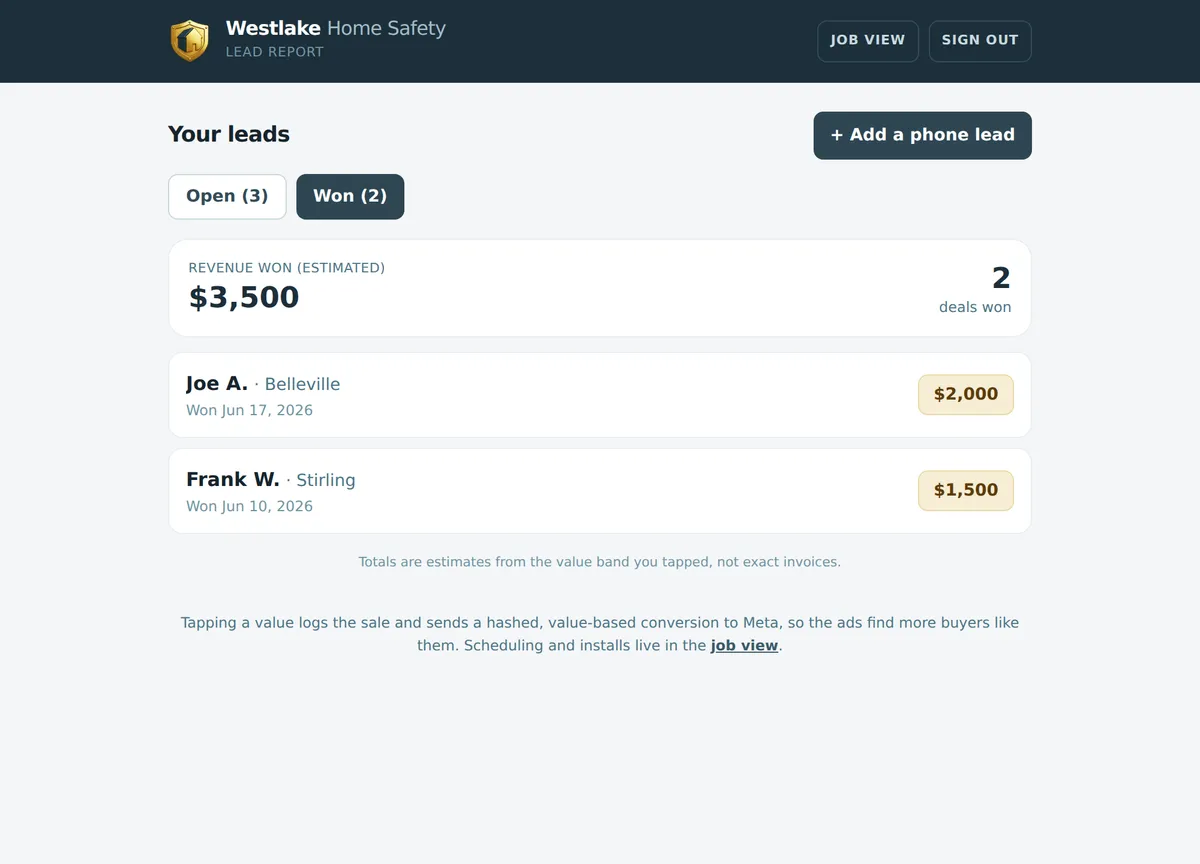
The portal closes that gap. When Westlake marks a lead won, the admin taps the rough value of the job, and the system sends a hashed, value-based conversion back to Meta through its Conversions API, matched to the original ad click. Meta then optimizes toward the customers who actually pay, weighted by what they pay, instead of whoever is cheapest to collect an email from. The same tap builds an honest revenue tally the owner can read at a glance.
The outcome
Westlake runs its ad spend into a system that tracks every inquiry from first click to finished installation, with no lead dependent on a single inbox, service, or memory. The client's service quality speaks for itself: Westlake holds the City of Belleville's 2026 Accessibility Excellence Award in the Customer Services/Education category (the published award listing renders the business name as “Westlake Home Security”).
By the numbers
- 14-page accessibility-first site serving 9 Ontario municipalities
- Full lead lifecycle tracked: new → contacted → assessment → quoted → booked → installed
- Installer isolation enforced at the database level
- Dual-path lead capture with no single point of failure
- Won deals fed back to Meta as hashed, value-based conversions, so ad spend optimizes on revenue
- Guides hub with cited Canadian public-health sources and structured data
Related reading: Field Teams Don't Have a Technology Problem.
Field crew working from yesterday's information?
Tell us how jobs move from inquiry to done in your operation. We will let you know if we can help.
Tell Us What’s Slowing You Down