Case Study · Our Own Business
Sprout IQ: We Migrated Our Own Business First
Neckles IO · Engagement 2026 · Belleville, Ontario
- Business
- Sprout IQ, a local lead-generation platform for local businesses, based in Belleville, Ontario, where it also publishes a community magazine. Owned and operated by Neckles IO's principal. This is our own system, not a client engagement.
- Engagement
- CRM migration, automation platform, website replatform
- Stack
- Twenty CRM (self-hosted), n8n, Astro, Cloudflare (Pages + serverless edge functions), AI enrichment under governance
Let us be clear about something before the numbers: Sprout IQ is ours. It is the business our principal owns and runs: a local lead-generation platform (landing pages, a lead portal, and managed ads) that brings qualified leads to local businesses, grown out of the hand-delivered community magazine we still publish in Belleville. The other case studies on this site are client engagements. This one is the system we built for ourselves, and we are telling you that up front because it is the entire point.
Sprout IQ's own sales motion is outbound: to win clients for the platform, thousands of local companies are contacted methodically, across dozens of business categories. That motion ran on Pipedrive, and the problems were the same ones our clients describe. The subscription cost was the smaller issue. The larger one was structural: the prospect database, the automation logic, and the email history all lived inside a vendor's walls, shaped by a vendor's data model. Before asking any client to trust our migration protocol, we ran the whole thing on our own business first.
Four phases, each with a gate
The migration followed our standard delivery protocol (audit, implementation, migration, training) with a gate at the end of each phase. When we run this protocol for clients, each gate closes with the client's sign-off; here, the gates closed against the same written acceptance criteria.
Audit. Before anything was built, we produced a utilization report that quantified what the existing CRM actually did for the business: which features were used, which were paid for and ignored, and where data quality had decayed. The migration decision was made on evidence, not enthusiasm.
Implementation. We deployed a self-hosted Twenty CRM instance on infrastructure Sprout IQ controls, with a data model built around how the business actually sells: a 50-category business taxonomy (the platform works with one business per category, per area), magazine-edition tracking for the print publication, and qualification fields that match the pitch process, none of which a rented CRM's defaults would ever express.
Migration. The legacy data (more than 5,000 organizations) was expanded against a fresh market scrape to over 8,000 in-scope companies, then enriched and scope-filtered using AI under deterministic validation: every machine-made claim passed through typed failure checks, and the model was never allowed to grade its own work. Roughly 1,400 contacts were migrated with seeded random spot-checks, independent re-verification of every linkage, and rollback scripts staged for every change. Cutover happened in a planned window with a post-cutover smoke test.
Training. For clients, this phase ends with an admin runbook, live training, and a formal handover of ownership. For our own business, the equivalent discipline is that the system runs as documented production infrastructure (runbooks, version control, and monitoring), not as the founder's personal project that only he can operate.
117 workflows in production, deployed like software
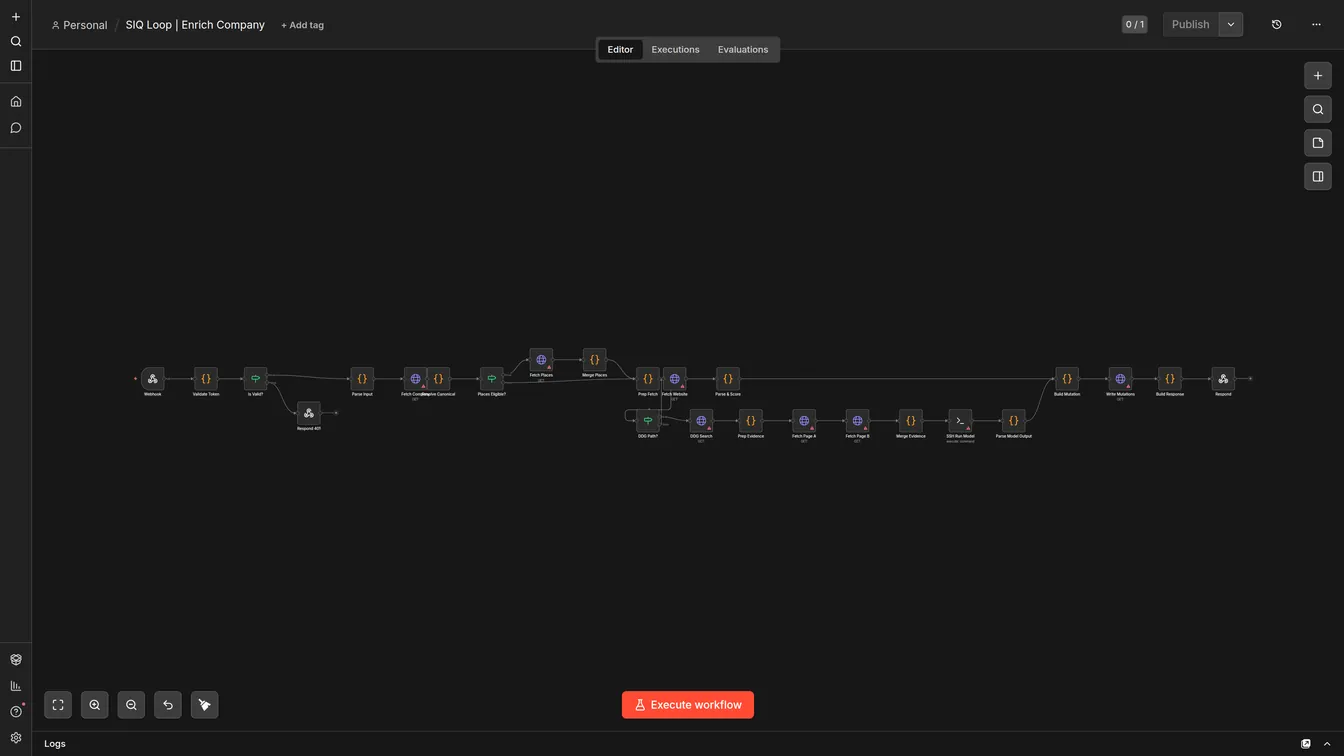
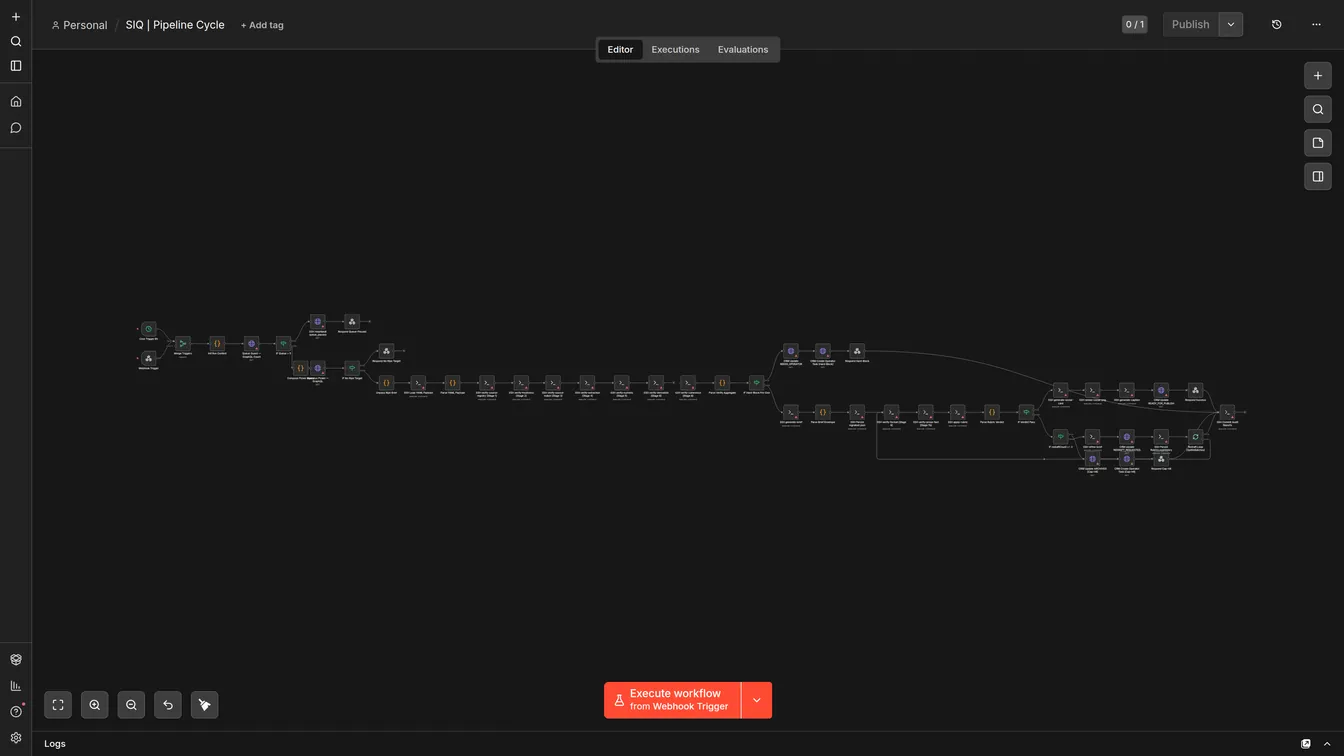
The CRM is the system of record; the automation around it is where the labour disappears. Sprout IQ runs 117 n8n workflows in production as of June 2026: lead intake, email sync and drafting, prospect enrichment, deduplication, pitch-window eligibility, and the pipeline that feeds the magazine content process.
Every workflow is version-controlled and deployed from the repository, one-way, through CI. Nothing is hand-edited in a browser and forgotten. When a workflow changes, there is a commit that says what changed and why. It is the same discipline software teams expect, applied to business automation.
The website came off the rental, too
Midway through the engagement, Sprout IQ's public site was replatformed from Webflow to Astro on Cloudflare Pages. The risk in a replatform is invisible: search rankings built over years, lost to careless URL handling. We held SEO parity across 795 indexed URLs, verified before cutover, and decommissioned Webflow only after the parity report said go.
The outcome
The stack is owned outright: the CRM, the data, the automation, and the website. The subscription line items are gone, and the system models the business instead of the other way around. And because Sprout IQ is ours, this case study is something a client logo cannot be: proof that we run our own company, every day and in production, on exactly what we sell. Our homepage says we run on what we sell; this page is what that means.
By the numbers
- 8,000+ company records migrated and AI-enriched under deterministic validation
- ~1,400 contacts migrated with seeded spot-check verification and staged rollbacks
- 117 n8n automation workflows in production (as of June 2026), deployed from version control
- 795 indexed URLs held at SEO parity through the Webflow-to-Astro cutover
- 4 delivery phases, each closed against written acceptance criteria
Related reading: The Moment Your CRM Starts Costing You Deals and Your CRM Data Is Dirty Because of How Leads Enter It.
Outgrowing your CRM?
Tell us where the manual work lives today. We will let you know if we can help.
Tell Us What’s Slowing You Down