Case Study · Local Retail Commerce
Sheds For Less: A Dealer Network That Runs Itself
Neckles IO · Engagement 2026 · Ontario
- Client
- Sheds For Less, resin shed distributor serving the GTA, Kingston, Ottawa, and Eastern Ontario
- Engagement
- Marketing site, reservation flow, dealer portal, lead distribution automation
- Stack
- Owned relational database with row-level security, automation layer, static edge hosting, transactional email
Sheds For Less sells storage sheds through a network of dealers across Ontario. Before this engagement, lead handling looked the way it does at most small dealer networks: inbound inquiries arrived by email, someone forwarded them to whichever dealer seemed right, and follow-up lived in memory and group texts. Nobody could say with confidence who had which lead, what had happened to it, or which commissions had been paid.
We wrote about why this happens, and why enterprise dealer-management software is the wrong answer for a network this size, in a separate article. This is what we built instead.
Isolation enforced where it cannot be bypassed
The portal gives every dealer a clean view of their own leads and nothing else. The important word is enforced: dealer isolation is implemented as row-level security in the database itself, not as a filter in the interface. A dealer cannot reach another dealer's pipeline through the app, through the API, or through any path at all, because the database refuses.
Admins see the whole network: every lead, its status, its assigned dealer, the commission owed and whether it has been paid, and the scheduled delivery and installation dates. Walk-ins and phone leads are logged manually into the same system, so there is one record of the business, not two.
The moment of assignment is automated
The step that kills leads in a manual system is notification lag: a lead sits in a spreadsheet until the dealer happens to look. Here, the moment an admin assigns a lead, an automation picks up the change and emails the dealer everything needed for first contact: name, phone, location, shed size, site details.
Status updates are one tap. New-lead alerts to admins carry signed, single-use action buttons (mark contacted, mark quoted, mark lost) that work straight from the inbox and expire automatically, so a stale or copied link stops working.
Capture that survives failure
Lead capture is dual-path: every form submission writes to the database that feeds the portal and dispatches a conventional email. If any single service has a bad day, no lead is lost. The other path still fires. Bot traffic is filtered before it ever reaches the pipeline.
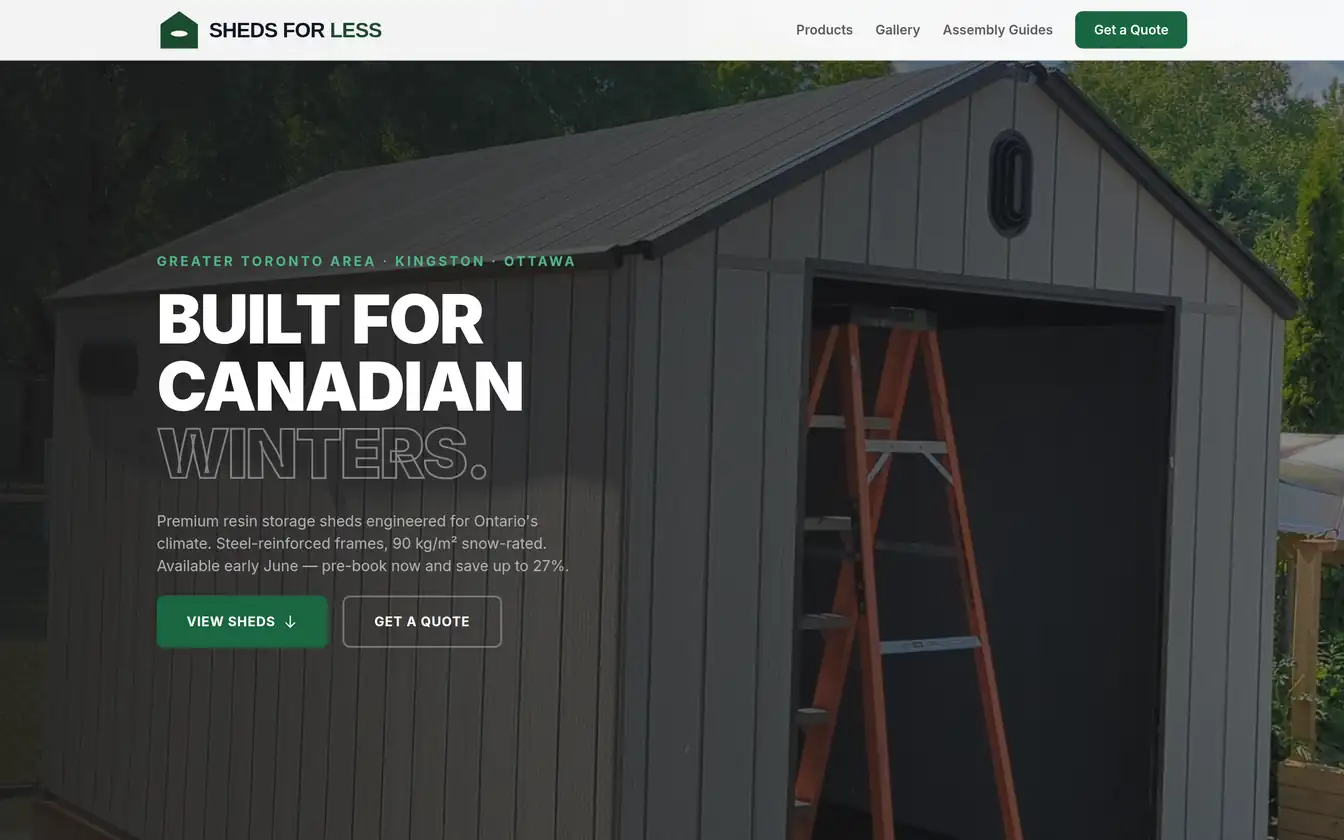
The product catalogue itself is data-driven: one source file generates the product cards, the size selectors, and the structured data that search engines read, with a CI check that refuses to ship the site if any of them drift apart. Prices on the page and prices in the schema cannot disagree.
The outcome
The system went live ahead of the client's launch. By opening day, 80% of pre-launch inventory had been reserved through the reservation flow, before the physical lot opened.
By the numbers
- 80% of pre-launch inventory reserved before opening day
- Dealer isolation enforced at the database via row-level security
- Automated dealer notification at the moment of lead assignment
- One-tap, signed single-use status actions from email
- Dual-path lead capture with no single point of failure
Related reading: Why Most Dealer Networks Run on Spreadsheets and Group Texts.
Running a dealer or partner network on spreadsheets?
Tell us how leads move through your operation today. We will let you know if we can help.
Tell Us What’s Slowing You Down